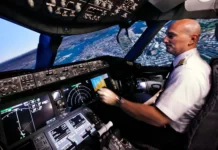



 CAE announced that it will begin training the first pilots for Bombardier’s new Global 8000 business jet this year, marking a key milestone toward the aircraft’s entry into service. As Bombardier’s Authorized Training Provider (ATP), CAE is delivering training to support operators of the new Global 8000 business jet to ensure they are fully prepared for the aircraft’s operational debut.
Pilot training for the Global 8000 will begin at CAE’s Montreal training centre in early December, with plans to expand to additional CAE locations within its network as the in-service fleet grows.
“The Global 8000 is a significant advancement in business aviation, and CAE is proud to support Bombardier by delivering world-class pilot training for this aircraft,” said Alexandre Prévost, President, Civil Aviation, CAE. “Developed in close collaboration with Bombardier, our Global 8000 training program leverages next-generation simulator technology, advanced courseware, expert instruction, and CORe training powered by CAE Rise, to reflect the performance and sophistication of Bombardier’s newest flagship aircraft.”
“The Global 8000 is the fastest business jet on the market with the lowest cabin altitude of any civil aircraft. Bombardier is thrilled to be working alongside CAE to provide essential instruction and training programs for pilots and our service and support teams,” said Anthony Cox, VP Customer Support, Bombardier. “With this comprehensive training package, we can ensure that all aspects of the customer journey exceed expectations, providing customers with a truly excellent flying experience.”
In addition to pilot instruction, CAE has launched a suite of maintenance training programs for the Global 8000, reinforcing safety, coordination, and teamwork on the ground. This includes differences training, now available via Computer-Based Training (CBT), a specialized program for technicians who work on other aircraft in the Global series and need to learn the specific differences in the Global 8000. CAE also offers, for the Global 8000 and all aircraft in the Global series, CBT Ground School for Engine Run & Taxi (ERT) and Crew Resource Management (CRM) training for Aircraft Maintenance Technicians—developed in conjunction with ERT. These maintenance technician training courses are given at all of CAE’s training centres worldwide, at a customer’s location, or via live remote training using special hybrid training rooms.
CAE publishes standard operating procedures for bizjet safety
CAE announced the publication of the Airplane Standard Operating Procedures (SOP) Manual for business and general aviation to enhance safety in training and day-to-day operations. The SOPs were developed by the National Business Aviation Association (NBAA) in collaboration with CAE, aircraft manufacturers, operators, and other training experts to promote consistent, proven standards for both multi- and single-pilot operations.
Recognising that many business aviation operators manage fleets of two aircraft or fewer and may lack the resources to build their own training programs, these standardised procedures offer a valuable framework that supports operational consistency across the industry, with particular benefit to smaller operations.
“The industry-wide collaboration to establish these SOPs shows that safety transcends everything, as everyone wins with safer skies,” said Alexandre Prévost, President, Civil Aviation, CAE. “By embedding these standards across our worldwide training programs, we are encouraging the industry to adopt a unified approach that extends beyond the classroom and into daily operations. This alignment not only enhances safety and operational consistency but also strengthens pilot resilience. Within CAE, this change reflects our deep commitment to mentoring our instructors and continuously elevating the training experience for our customers.”
The new SOPs will be introduced during training sessions starting in summer 2026, providing operators time to adapt to the updated standards. Ahead of the rollout, CAE will begin preparing its instructors in early 2026 to ensure a smooth integration into pilot training programs.

For Editorial Inquiries Contact:
Editor Matt Driskill at matt.driskill@asianaviation.com
For Advertising Inquiries Contact:
Head of Sales Kay Rolland at kay.rolland@asianaviation.com