
What killed Boeing’s CEO?
A series of missteps, two plane crashes, 346 dead passengers, and a failed space mission along with a bit of hubris led to downfall of Dennis Muilenburg. Questions remain as to how much Boeing will actually change under its new leadership team.
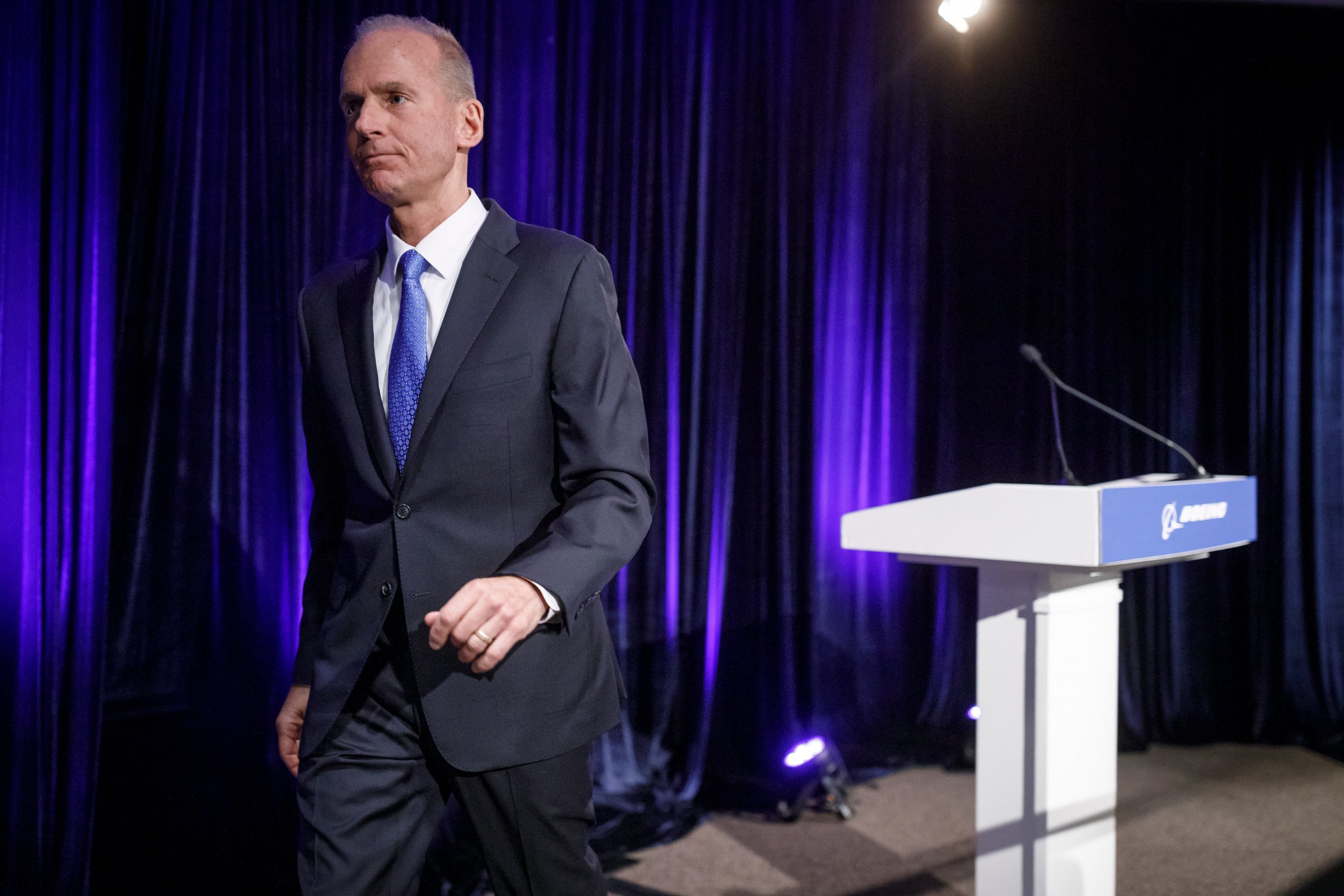
In the end, it was the clock in the capsule that killed ousted Boeing CEO Dennis Muilenburg. Not literally of course, but the failure of Boeing’s Starliner space capsule that was to herald a US return to manned space flight on a US vehicle appears to have been the straw that broke the camel’s back and led to Muilenburg’s ouster as CEO on 23 December. It appears Boeing engineers, once hailed in the aerospace industry as the best of the best, could not set an internal clock properly on the spacecraft. The Starliner’s failure to perform as planned came on top of a nearly year-long grounding of its best-selling 737 MAX narrowbody jet, which was the result of two crashes that together killed 346 people. Muilenburg was slammed by relatives of the victims, US congressional investigators, the US Federal Aviation Administration, and many others for his handling of the fallout from those two crashes. A Boeing “lifer” and engineer by training, Muilenburg never seemed to get a grip on how to handle the crisis and seemed to be, in his public appearances at press conferences and congressional hearings, simply repeating lines that sounded like they had been written by the company’s lawyers, and they probably were. Don’t cry for Muilenburg though. Even though he was fired just two days before Christmas, he is eligible for a US$39 million payout, including US$6.6 million in cash as well as bonuses and stock awards, based on share price of US$322.50, according to regulatory filings and media reports. That’s far more than any relatives of the 346 dead passengers will be receiving in any settlement with Boeing, which has been trying to move the legal cases against it to Indonesia and other jurisdictions where payouts are normally far less than what might be awarded by courts in the US. Muilenburg’s handling of the two crashes of Boeing’s 737 MAX plane led to his ouster. (PHOTO: Shutterstock) Boeing, in its 23 December statement announcing the leadership change, said the board of directors “decided that a change in leadership was necessary to restore confidence in the company moving forward as it works to repair relationships with regulators, customers, and all other stakeholders”. Boeing’s board in October stripped Muilenburg of his chairman’s title and replaced him in that seat with David Calhoun, who will now take over as CEO and president. Calhoun will remain as a member of the board but will be replaced in the chairman’s role by Lawrence Kellner. Boeing Chief Financial Officer Greg Smith will serve as interim CEO during the brief transition period, while Calhoun exits his non-Boeing commitments, the company added. Read More New Boeing CEO tasked with fixing rifts he and the board helped cultivate Analysis: Calhoun’s insider status raises question: is he the one to pull Boeing out of its dive? Boeing’s Starliner spacecraft makes safe landing after botched test flight Boeing CEO Chastised by FAA as Tensions Risk 737 Max Delay David Calhoun, Boeing’s new CEO. (PHOTO: Boeing) The problem with appointing Calhoun as CEO – he was in the running for the position previously – is that Boeing has been criticised for putting profits before people (i.e., safety), and Calhoun is unlikely to change that corporate mindset, coming as he does from General Electric where “financial engineering” is the name of the game. Calhoun has been on the Boeing board since 2009 and has been a strong proponent of cost-cutting that many blame for Boeing’s troubles. His past at GE and his focus on finances means safety, despite all the press releases Boeing may send out to the contrary, will take a backseat to shareholder value. Boeing has a long way to go to restore trust with regulators around the world, with Wall Street, with airlines that have lost millions of dollars due to the grounding of the MAX, pilots and air crews, and not least, the flying public. Pilots have slammed Boeing because the manufacturer failed to include details about a flight-control subsystem known as Manoeuvring Characteristics Augmentation System (MCAS) that played a role in the accident. While the company had described MCAS to MAX operators, it deliberately removed references from flight-crew manuals in its rush to get the MAX into the air and into competition against the Airbus A320.
Previous article
Aviation News in Brief 21 Dec 2019
Matt Driskill is the Editor of Asian Aviation. He has been an Asia-based journalist and content producer since 1990 for outlets including Reuters and the International Herald Tribune/New York Times and is a former president of the Foreign Correspondents Club of Hong Kong. He appears on international broadcast outlets like Al Jazeera, CNA and the BBC and has taught journalism at Hong Kong University and American University of Paris. In 2022 Driskill received the “Outstanding Achievement Award” from the Aerospace Media Awards Asia organisation for his editorials and in 2024 received a “Special Recognition for Editorial Perspectives” award from the same organisation. Driskill has received awards from the Associated Press for Investigative Reporting and Business Writing and in 1989 was named the John J. McCloy Fellow by the Graduate School of Journalism at Columbia University in New York where he earned his Master's Degree.
马特·德里斯基尔(Matt Driskill)是《亚洲航空》(Asian Aviation)的主编。他自1990年起,担任驻亚洲的记者和内容制作人,曾为路透社、国际先驱论坛报/纽约时报等媒体工作,并曾任香港外国记者协会会长。他也曾多次在半岛电视台、新加坡广播公司(CNA)和BBC等国际媒体担任嘉宾,并在香港大学和巴黎美国大学教授新闻学。2022年,德里斯基尔因其评论获得了航空媒体奖(Aerospace Media Awards Asia)颁发的“杰出成就奖”,2024年又因其编辑观点获得同一组织颁发的“特别表彰”。他曾获得美联社的调查报道和商务写作奖,并于1989年被纽约哥伦比亚大学研究生新闻学院授予约翰·J·麦克劳伊学者(John J. McCloy Fellow)称号,获得硕士学位。
Comments
Loading comments...