
Home › Airlines
Singapore Airlines says revenue surges but net profit hit by fuel prices
By Asian Aviation Staff
•Nov 12, 2026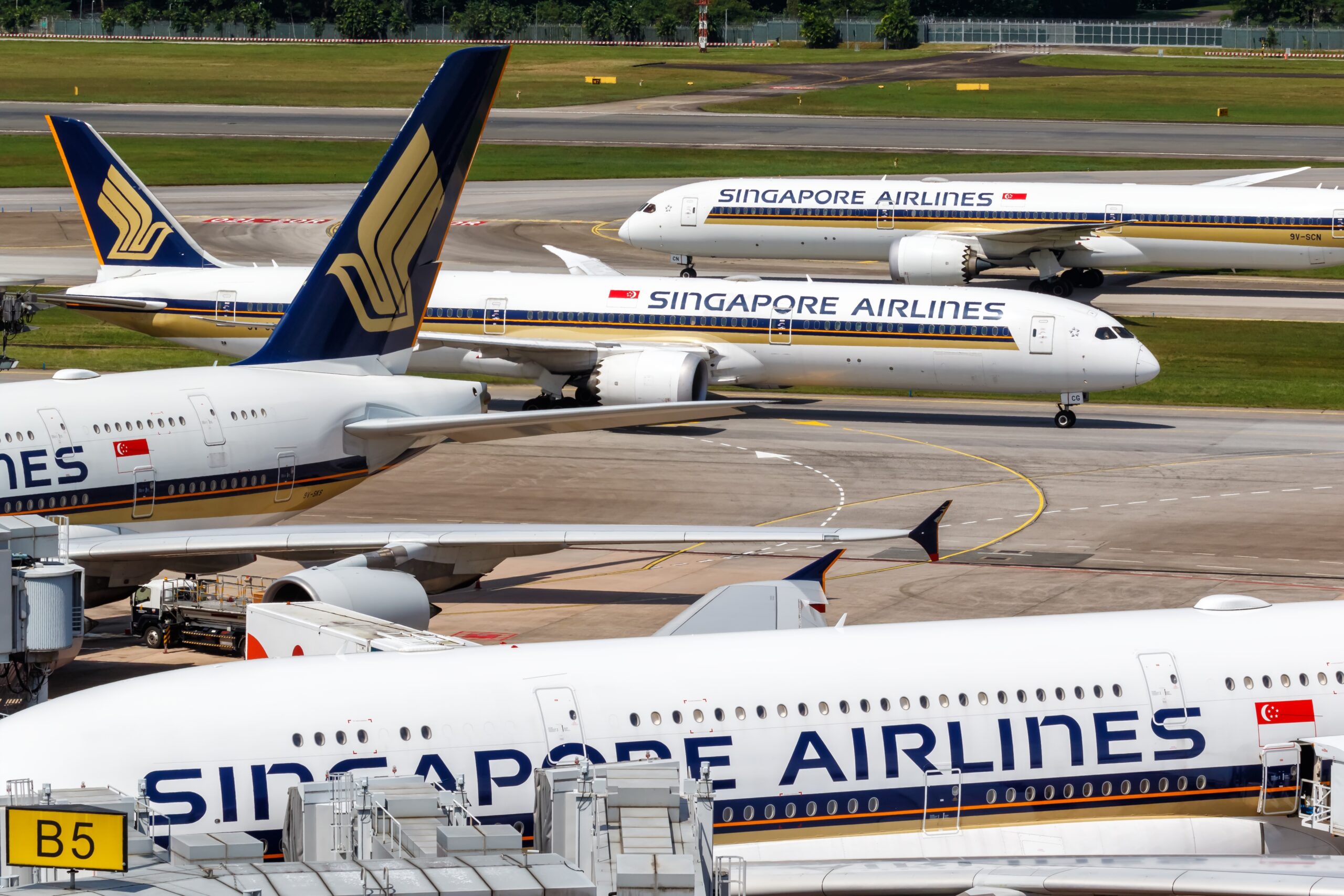
Singapore Airlines said it achieved a record half-year revenue of 11.3 billion Singapore dollars ($8.4 billion) as travel demand boomed across the Asia-Pacific region, but an 87% surge in jet fuel prices driven by geopolitical conflict in the Middle East slashed its first-half net profit by nearly 44%. The flag carrier announced Wednesday that its net profit for the six months ended Sept. 30 tumbled to 134 million Singapore dollars, down from 239 million Singapore dollars a year earlier. Operating profit dropped 29.1% to 569 million Singapore dollars, down from 803 million Singapore dollars in the prior-year period, as surging operating expenditure eclipsed double-digit passenger and cargo growth. Singapore Airlines is upgrading its interiors and in-flight product. (IMAGE: Singapore Airlines) The financial results reflect a stark paradox confronting global aviation: consumer appetite for international flights and commercial air freight remains near historic highs, yet regional armed conflicts and energy market shocks have sent airline operating costs spiraling. “The airline industry operates in an uncertain environment, with volatile geopolitical developments, including the conflict in the Middle East, adding complexity across operations and supply chains,” the airline said in a statement accompanying its financial results. “Jet fuel prices remain elevated relative to pre-conflict levels, and continue to place significant pressure on costs. While the Group has adjusted air fares and cargo rates, these measures do not fully offset the impact of sustained high fuel prices”. Despite the half-year profit contraction, Singapore Airlines demonstrated operational resilience in the July-to-September second quarter, mounting a sharp financial rebound that saw quarterly net profit more than quadruple to 210 million Singapore dollars, up from 52 million Singapore dollars a year earlier. Confident in its liquidity and balance sheet, the board of directors declared an interim ordinary dividend of 2 cents per share along with an interim special dividend of 5 cents per share, returning 7 cents per share to investors on Dec. 11. Fuel Shock Erodes Revenue Gains Revenue for the first half of the 2026/27 financial year grew 16.8% to 11.297 billion Singapore dollars, an increase of 1.622 billion Singapore dollars from the 9.675 billion Singapore dollars recorded during the corresponding period last year. However, overall group operating expenses escalated faster than sales, swelling 20.9% to 10.728 billion Singapore dollars from 8.872 billion Singapore dollars. The primary driver of that cost inflation was aviation fuel. Fuel cost before hedging skyrocketed 90.3%, or 2.233 billion Singapore dollars, to 4.705 billion Singapore dollars. The carrier reported that the average market price of jet fuel over the six months reached $171 per barrel, an 86.7% spike compared to the same period in 2025, heavily distorted by instability surrounding Middle Eastern oil transport corridors and refining hubs. Singapore Airlines cushioned the blow through financial risk management. The group booked a net fuel hedging gain of 731 million Singapore dollars for the half year, reversing a 75 million Singapore dollar hedging loss incurred during the first half of the prior fiscal year. That swing represented an 806 million Singapore dollar positive variance. Even with hedging gains credited, net fuel expenditure expanded 56.0% to 3.974 billion Singapore dollars, consuming more than a third of the group’s total top-line revenue. Non-fuel expenditures rose 6.8% to 6.754 billion Singapore dollars, compared with 6.325 billion Singapore dollars a year ago. Management attributed the rise to capacity expansion, higher flight activity, and general inflationary pressure across wages, ground handling, and airport user charges. The financial damage of the fuel surge was concentrated heavily in the first quarter. Group operating profit plunged 73.8%, or 299 million Singapore dollars, during the April-to-June quarter, proving to be the primary drag on the six-month performance. Passenger Records and Cargo Strength Even as fuel prices battered margins, Singapore Airlines and its low-cost subsidiary, Scoot, set commercial traffic records. Passenger flown revenue climbed 16.8% to 9.095 billion Singapore dollars, up by 1.308 billion Singapore dollars. Together, the parent carrier and Scoot flew 21.8 million passengers over the six months, a 5.0% increase over the 20.8 million travelers flown during the same timeframe in 2025. Passenger capacity, measured in available seat-kilometers, expanded 4.9% to 94.19 billion. Traffic, measured in revenue passenger-kilometers, grew 3.8% to 81.73 billion. Because capacity growth slightly outpaced demand, group passenger load factor dipped 0.9 percentage points to a still-robust 86.8%. Strong booking demand enabled the group to maintain pricing power. Group passenger yield—a standard industry metric tracking the average revenue collected per passenger per kilometer flown—advanced 12.1% to 11.1 Singapore cents, up from 9.9 cents. Air cargo operations also delivered a significant turnaround. Cargo revenue jumped 30.2% to 1.394 billion Singapore dollars, a 323 million Singapore dollar increase. Air cargo yields jumped 25.4% to 43.5 cents per load tonne-kilometer. Cargo loads climbed 4.0% to 3.20 billion tonne-kilometers, while freighter and belly-hold cargo capacity remained virtually flat, nudging up just 0.4%. As a consequence, cargo load factor gained 2.0 percentage points to 58.5%. Company executives noted that the air cargo rebound was stimulated by strong international logistics demand for semiconductor shipments and cloud computing equipment. In addition, protracted disruptions and heightened risks in maritime shipping lines pushed freight forwarders to shift high-value cargo from ocean vessels to air transit. Second Quarter Pivot The airline’s second-quarter turnaround between July 1 and Sept. 30 offered evidence of stabilizing earnings. Second-quarter revenue reached a record 5.583 billion Singapore dollars, an increase of 14.3% from 4.885 billion Singapore dollars during the same period in 2025. Operating profit climbed 16.3% to 463 million Singapore dollars, compared with 398 million Singapore dollars a year earlier. Second-quarter passenger flown revenue increased 15.0% to 4.513 billion Singapore dollars, supported by a 12.2% increase in passenger yields and a 2.3% uptick in passenger carriage. Cargo revenue gained 26.9% to 686 million Singapore dollars as cargo yields improved 22.3% and tonnage volume grew 3.9%. Net profit for the three-month period jumped by 158 million Singapore dollars to 210 million Singapore dollars. Beyond operating performance, bottom-line results were lifted by a sharp reduction in equity losses recognized from associated companies. In particular, Indian flag carrier Air India—in which Singapore Airlines owns a 25.1% strategic stake—narrowed its financial losses, reducing drag on the Singapore parent company by 110 million Singapore dollars during the quarter. For the combined half-year, Air India’s narrowed losses contributed a net positive variance of 68 million Singapore dollars toward group earnings, while lower corporate tax provisions provided an additional 70 million Singapore dollar benefit. Performance Split: Premium vs Budget Operating statistics highlighted differing dynamics between premium full-service mainline brand Singapore Airlines and low-cost unit Scoot. Mainline Singapore Airlines carried 14.09 million passengers during the half year, up 3.0%. Available seat capacity grew 3.9%, while traffic increased 2.6%, bringing passenger load factor down 1.1 percentage points to 85.6%. Premium passenger yields rose 11.8% to 12.3 cents per kilometer. Due to fuel inflation, mainline unit passenger costs surged 15.6% to 10.4 cents per available seat-kilometer. Mainline unit cost excluding fuel remained well controlled, edging down 1.6% to 6.0 cents. The passenger breakeven load factor for the parent carrier moved up 2.8 percentage points to 84.6%. Budget carrier Scoot experienced rapid volume and yield growth. Scoot transported 7.73 million passengers during the six months, an 8.9% increase over 2025. Capacity rose 8.7% and traffic climbed 7.9%. Scoot’s passenger load factor remained elevated at 90.8%, a minor drop of 0.7 percentage points. Scoot achieved an extraordinary 21.7% surge in passenger yields, which climbed to 7.3 cents per kilometer from 6.0 cents. Revenue per available seat-kilometer jumped 20.0% to 6.6 cents. Scoot’s passenger unit costs expanded 18.3% to 7.1 cents, while its unit cost excluding fuel rose 4.9% to 4.3 cents. Because yield gains outstripped cost increases, Scoot’s breakeven load factor improved significantly, falling 2.7 percentage points to 97.3% for the half year, and dropping 7.2 percentage points to 94.5% during the second quarter. Capital Management and Balance Sheet Singapore Airlines ended September with 8.98 billion Singapore dollars in total cash and liquidity. This consisted of 8.12 billion Singapore dollars in cash and bank balances, up 191 million Singapore dollars over six months, alongside 855 million Singapore dollars in long-term fixed deposits maturing past 12 months. The group retained 3.23 billion Singapore dollars in committed, undrawn credit lines with commercial banks. Total debt decreased by 637 million Singapore dollars to 10.01 billion Singapore dollars. The airline redeemed a maturing $500 million fixed-rate bond (valued at 666 million Singapore dollars) and made scheduled loan repayments of 338 million Singapore dollars. These debt pay-downs were partially offset by issuing an offshore Chinese yuan-denominated bond totaling 1.50 billion yuan (282 million Singapore dollars) with a five-year maturity. As of Sept. 30, group shareholders’ equity stood at 16.45 billion Singapore dollars, down 815 million Singapore dollars from March 31, following annual dividend distributions. The group’s debt-to-equity ratio improved slightly to 0.61 times, down from 0.62 times six months earlier. Net asset value per share was 5.22 Singapore dollars. Operating cash generation remained strong. The company generated 2.50 billion Singapore dollars in net cash from operations and liquidated 911 million Singapore dollars in matured fixed-deposit instruments. Capital expenditures consumed 1.11 billion Singapore dollars, bond and debt retirements totaled 994 million Singapore dollars, and dividend distributions accounted for 915 million Singapore dollars. The interim ordinary dividend of 2 cents per share and special dividend of 5 cents per share fulfill the board’s three-year capital return program adopted in November 2025, which pays 10 cents per share in special dividends annually across fiscal years 2025/26 through 2027/28, amounting to approximately 900 million Singapore dollars. Fleet Investments and Middle East Disruption The group’s total operating fleet stood at 224 aircraft as of Sept. 30, with an average fleet age of seven years and 11 months. Mainline Singapore Airlines operated 152 passenger aircraft and seven dedicated Boeing 747-400 freighters. The passenger fleet comprised 65 Airbus A350s, 28 Boeing 787-10s, 25 Boeing 737-8s, 22 Boeing 777-300ERs, and 12 Airbus A380 superjumbos. Scoot operated 65 aircraft, including 14 Airbus A321neos, 13 Airbus A320neos, 13 Boeing 787-8s, 11 Boeing 787-9s, nine Embraer E190-E2 regional jets, and five Airbus A320ceos. During the second quarter, Singapore Airlines accepted two new Boeing 737-8 aircraft, while Scoot took delivery of two Airbus A321neos. The group maintains firm order books for 58 new aircraft: 24 from Airbus (11 A320neos, six A321neos, and seven A350F freighters) and 34 from Boeing (31 flagship 777-9s and three 787 Dreamliners). Geopolitical instability in the Middle East has altered flight routing and commercial schedules. The airline confirmed that Scoot’s regular services to Jeddah, Saudi Arabia, and Singapore Airlines’ mainline flights to Dubai, United Arab Emirates, remain indefinitely suspended. The planned inaugurating service from Singapore to Riyadh, Saudi Arabia, originally scheduled for late 2026, has been pushed back to March 2027. The carrier said it is redirecting flying hours to stable, high-yield alternative routes in Europe, North Asia, and Oceania. In Southeast Asia, Scoot opened direct links from Changi Airport to the Indonesian leisure destinations of Belitung and Pontianak, and added a route to Guiyang, China, marking Scoot’s 16th mainland Chinese destination and the group’s 23rd. Mainline Singapore Airlines launched daily direct flights to Hangzhou, China, and added weekly flight frequencies to Amsterdam, London Gatwick, and Manchester. For the Northern Winter operating season, which runs from Oct. 25, 2026, to March 27, 2027, Singapore Airlines is stepping up frequencies to Adelaide, Auckland, Milan, Munich, Ho Chi Minh City, and Da Nang. It is also launching seasonal ski flights to Sapporo, Japan, and introducing two new destinations: a five-times-weekly route to Madrid via Barcelona, and daily service to Australia’s new Western Sydney International Airport. The Western Sydney service will operate alongside the carrier’s existing four daily flights into Sydney Kingsford Smith Airport, expanding Singapore Airlines’ footprint to five daily departures into the Sydney metropolitan basin. Strategic Partnerships and Product Refresh Singapore Airlines continues to rely on international airline equity stakes and commercial codeshares to diversify beyond its home market. Central to that strategy is its 25.1% holding in Air India, which is undergoing a multi-billion-dollar restructuring under the ownership of Tata Sons. In October, the carriers initiated the first phase of joint network initiatives under their Commercial Cooperation Framework Agreement signed in January 2026, offering coordinated schedules and seamless booking connectivity across eight Indian primary hubs. The alliance will expand further in early 2027 with reciprocal frequent-flyer redemptions and elite status recognition. Regionally, Singapore Airlines introduced a joint fare product with Malaysia Airlines in June 2026. It signed memorandums of understanding with Air China to pursue joint schedule coordination and frequent-flyer reciprocity, and with Vietnam Airlines to link loyalty privileges. In cargo, Singapore Airlines extended its operating agreement with DHL Express, under which Singapore Airlines pilots operate and maintain five DHL-owned Boeing 777 freighters based at Changi Airport. To maintain its premium market position, Singapore Airlines hosted a global product showcase in Singapore on Nov. 6, unveiling a comprehensive cabin refresh. The investment covers redesigned First Class, Business Class, Premium Economy, and Economy seats, alongside an upgraded KrisWorld in-flight entertainment software architecture, satellite broadband connectivity, overhauled lounge facilities, and revamped dining menus. The product rollout followed major international recognition: Singapore Airlines secured the World’s Best Airline title for the sixth time at the Skytrax World Airline Awards in September, with Scoot winning World’s Best Long-Haul Low-Cost Carrier. On decarbonization, Singapore Airlines highlighted a three-year offtake contract signed with Aether Fuels to purchase up to 4,800 tonnes of sustainable aviation fuel beginning in 2028, produced at Aether’s forthcoming synthetic fuel facility in Singapore. The group reaffirmed its target to reach net-zero greenhouse gas emissions by 2050. Industry Outlook The global aviation industry faces a delicate path through early 2027. Singapore Airlines warned that ongoing hostilities in the Middle East risk broader economic fallout, including stubborn inflationary pressures and volatile exchange rates that could eventually dent corporate travel and leisure demand. Nevertheless, forward bookings for year-end holiday flights remain solid, and semiconductor and electronics shipments continue to anchor freight revenues. “The group is in a strong position to navigate this volatility,” Singapore Airlines stated. “Its diversified global network and broad mix of traffic flows help to cushion shifts in demand, while the complementary positioning of Singapore Airlines and Scoot enables them to serve different markets and customer segments, and adjust capacity and schedules with agility.” For Editorial Inquiries Contact: Editor Matt Driskill at [email protected] For Advertising Inquiries Contact: Head of Sales Sally Passey at [email protected]
TAGSSingapore Airlines
Previous article
Cathay Group places firm order for 14 additional Airbus aircraft
Asian Aviation Staffhttps://asianaviation.com/
Asian Aviation staff is comprised of award-winning journalists based throughout the Asia-Pacific region led by Editor Matt Driskill. 《亚洲航空》的编辑团队由主编马特·德里斯基尔 (Matt Driskill) 带领,汇聚了遍布亚太地区的获奖记者。