
Korean Air, Skyports partner on eVTOL platform
By Asian Aviation Staff
•Mar 1, 2026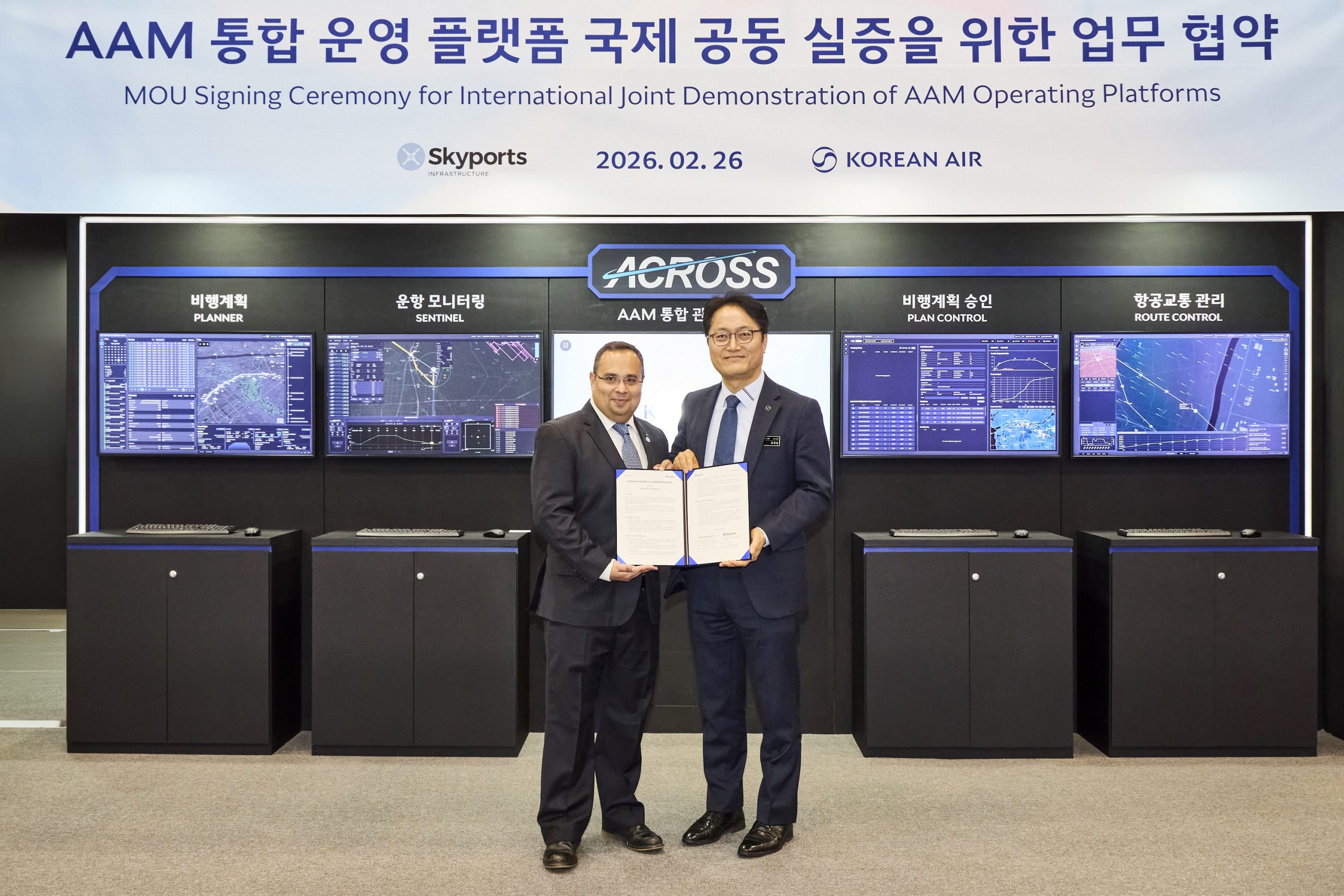
Korean Air has partnered with Skyports Infrastructure (Skyports) to develop a platform for electric vertical takeoff and landing (eVTOL) operations. The two parties signed a Memorandum of Understanding (MoU) at Drone Show Korea (DSK) 2026 at BEXCO in Busan. The ceremony was attended by Kyung Nam Kim, Managing Vice President and Head of the Korean Air R&D Center, and Ankit Dass, Chief Technology Officer of Skyports. Under this partnership, the two parties will develop an integrated platform by interlinking their proprietary technologies: Korean Air’s ACROSS (Air Control & Routing Orchestrated Skyway System) for flight operations and air traffic management, and Skyports’ VAS (Vertiport Automation System) for vertiport infrastructure control. The platform aims to manage the end-to-end passenger journey, including vertiport check-in, security screening, boarding, and arrival procedures. The partners plan to conduct joint demonstrations and pilot programs in regions identified for early Advanced Air Mobility (AAM) commercialisation. The long-term objective is to provide scalable solutions for the AAM industry, positioning both companies as leaders in the global market. “ACROSS delivers integrated flight control and air traffic management for the low-altitude aviation environment,” said a Korean Air representative. “As vertiports serve as the essential interface for these operations, our partnership with Skyports, a global leader in infrastructure, is a critical milestone in building a safe and efficient AAM ecosystem.” Skyports is expanding its global vertiport footprint, with commercial operations in Dubai scheduled for 2026. This follows ongoing infrastructure projects in Abu Dhabi and the transition of the Downtown Manhattan Heliport in New York City into a dedicated AAM platform. Developed in 2024, Korean Air’s ACROSS provides comprehensive AAM fleet operations and air traffic management functions for low-altitude aircraft—including eVTOLs, drones, and helicopters. The platform manages flight schedules, flight plans, maintenance, flight monitoring and flight plan approval. As the first domestic entity to obtain UAM traffic management demonstration status, Korean Air validated the system’s performance through Phases 1 and 2 of the K-UAM Grand Challenge overseen by the Korean Ministry of Land, Infrastructure and Transport (MOLIT). Korean Air reduces carbon emissions through operational efficiency Korean Air said it has reduced its aircraft carbon emissions by more than 420,000 tons in 2025 through comprehensive fuel management and fleet modernisation. Data from the airline’s Q1 2026 Fuel Management Steering Committee showed 2025 flight emissions totaled 12,184,169 tons—a 3.3% reduction from 12,604,224 tons in 2024. Notably, this decrease was achieved despite a 2.6% increase in flight operations. This reduction is attributed to precise fuel management and collaboration across all operational sectors, including flight control, maintenance, and passenger services. Korean Air implemented several key initiatives to drive these reductions: Fleet modernisation: expanded operations of next-generation aircraft—including the Boeing 787-9/10, Airbus A350, and A321neo—to 41.6% of the total flights; Cruise speed optimisation: applied optimised Cost Index (CI) parameters to balance flight time and fuel consumption; Payload: enhanced Zero Fuel Weight (ZFW) predictions and Center of Gravity (CG) optimisation to minimise drag and fuel burn; Direct routing: coordinated with air traffic control for shortest flight paths to reduce distance and flight time; Optimal alternate airports: prioritised optimal alternate airports to lower required reserve fuel; APU usage minimisation: minimised ground Auxiliary Power Unit (APU) usage; Engine maintenance: conducted periodic core washing and precision tuning to maintain peak efficiency. Korean Air governs these efforts through a quarterly Fuel Management Steering Committee that audits performance and sets strategy. The airline also drives continuous improvement by incentivising employee-led carbon reduction ideas. Transitioning to an AI-powered digital system has also enhanced data precision. By analysing baggage and potable water weight, the airline improved weight prediction accuracy — technology recognised as a “Data Insight & Pioneer” winner at SkyTeam’s “The Aviation Challenge 2025”. “This reduction was driven by collaboration across all operational sectors and the participation of our employees,” said a Korean Air representative. “We remain committed to meeting our carbon reduction goals and continuing our journey toward sustainable aviation.” For Editorial Inquiries Contact: Editor Matt Driskill at [email protected] For Advertising Inquiries Contact: Head of Sales Sally Passey at [email protected]
Previous article
Gulfstream G700 earns certification in India
Asian Aviation staff is comprised of award-winning journalists based throughout the Asia-Pacific region led by Editor Matt Driskill. 《亚洲航空》的编辑团队由主编马特·德里斯基尔 (Matt Driskill) 带领,汇聚了遍布亚太地区的获奖记者。
Comments
Loading comments...