
Home › Environment
EcoCeres launches first SAF plant in Malaysia
Report: ASEAN could produce 8.5 million barrels of SAF daily by 2050
By Asian Aviation Staff
•Jan 27, 2026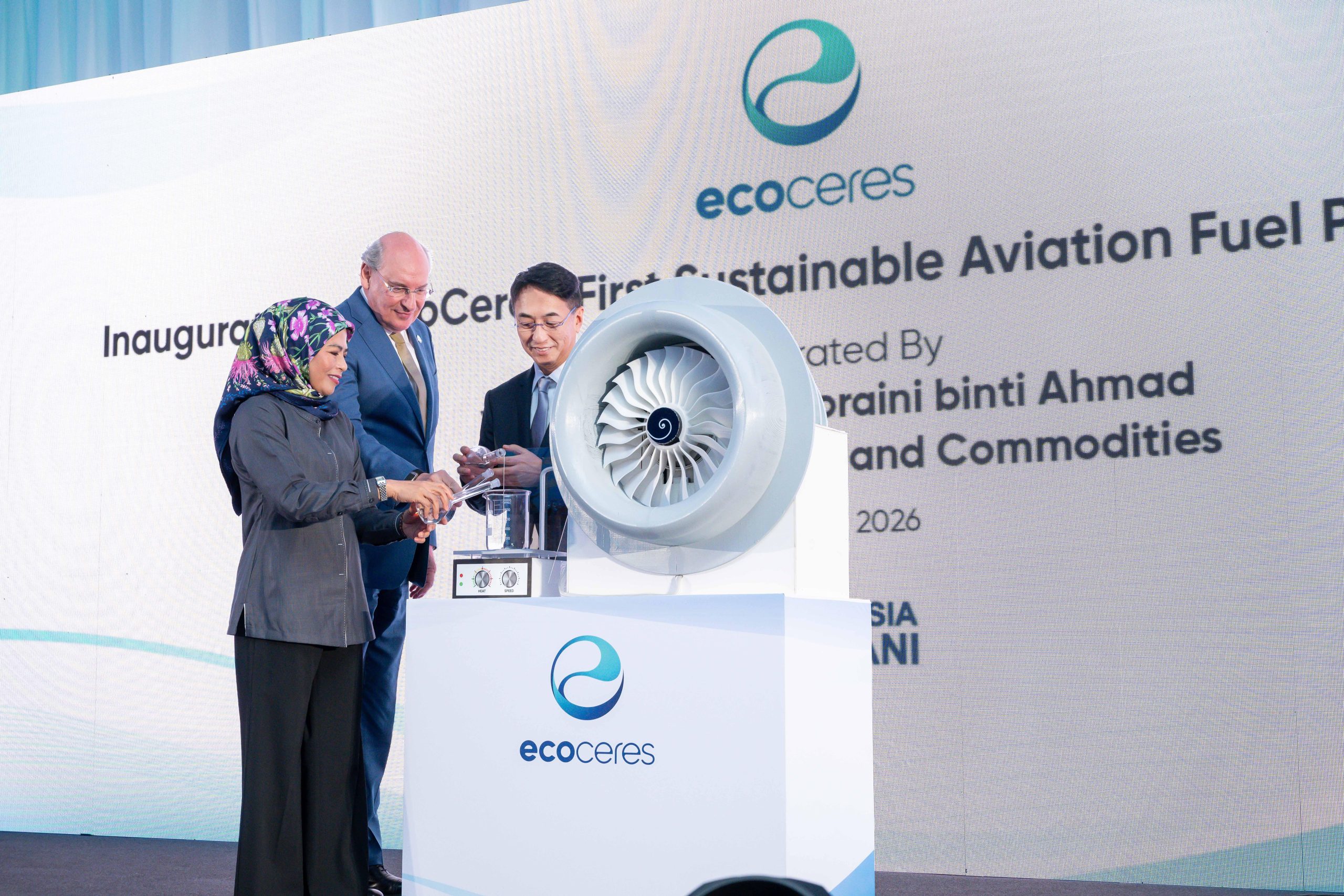
EcoCeres has officially launched its renewable fuel facility in Pasir Gudang, Johor, Malaysia, which the company says is the country’s first sustainable aviation fuel (SAF) production plant. Commissioning and start-up of the plant were successfully achieved in October 2025. The facility also produces hydrotreated vegetable oil (HVO) and renewable naphtha, with a combined maximum production capacity of 420,000 tonnes per year. Dr. Peter Lee, Chairman of Towngas and Principal of Full Vision Capital, said: “EcoCeres has grown from a laboratory in Hong Kong into one of the world’s leading producers of SAF, and this new Johor plant shows how regional commitment to sustainability can feed into the global search for climate solutions. With supportive government policies and the dedication of all our partners, we can turn the tide on climate change for future generations.” EcoCeres has developed its own proprietary waste to fuel processes in Hong Kong and successfully scaled them through its first facility in Zhangjiagang, China, which has helped the company become one of the world’s leading SAF producers by volume. “The Johor plant is a major step forward for EcoCeres’ regional platform and for Malaysia’s renewable fuel industry,” said Matti Lievonen, CEO of EcoCeres. “It also demonstrates our commitment to reliable supply capability and high product quality as customers’ demand for renewable fuel solutions accelerates. This facility supports Malaysia’s transition towards net-zero while strengthening Hong Kong’s strategic position as a regional hub for financing and scaling sustainable energy projects, enabling the supply of sustainable fuels to global industries. Our waste-to-fuel technology proves that economic growth and environmental stewardship can go hand-in-hand.” In addition to the Malaysian facility, EcoCeres’ Zhangjiagang plant also produces SAF and HVO bringing its combined maximum global renewable fuels capacity to approximately 770,000 tonnes per year and further enhancing Hong Kong’s role as the headquarters of an integrated regional renewable fuels platform. ASEAN could produce 8.5 million barrels of SAF daily by 2050 With the pressing need to decarbonise aviation, ASEAN economies could generate as much as 8.5 million barrels per day of Sustainable Aviation Fuel (SAF) by 2050, according to the ASEAN SAF 2050 Outlook report. Download the report here. The report provides a regional supply chain assessment for 2030, 2040, and 2050, examining potential SAF demand and supply scenarios across Cambodia, Indonesia, Lao PDR, Malaysia, the Philippines, Thailand, and Viet Nam, as well as import markets including Japan, Singapore, and the Republic of Korea (ROK). The report was developed by GHD through financial support provided by Global Affairs Canada from the Canadian Trade and Investment Facility for Development (CTIF) implemented by Cowater International (Cowater) in association with the Institute of Public Administrators of Canada (IPAC) and Global Affairs Canada, with Boeing as the knowledge partner, and supporting the ASEAN Secretariat. According to the SAF 2050 Outlook report, all the ASEAN countries examined could potentially have sufficient capacity to position themselves as net SAF exporters. Viet Nam, Indonesia, Malaysia, the Philippines, and Thailand have the most abundant feedstock to support SAF production, while Indonesia, Malaysia, the Philippines, may have the most cost-efficient distribution for markets in Japan, Singapore and ROK. In addition to exporting SAF, ASEAN is predicted to become a significant market for SAF in its own right. The report projects that SAF demand in ASEAN will grow sharply from 15,000 barrels per day in 2030, to over 700,000 barrels per day by 2050. The largest SAF demands are expected to come from Indonesia, Malaysia, Singapore and Thailand, as well as other Asian economies such as Japan and ROK. The report also examined different ways of producing SAF. Hydroprocessed Esters and Fatty Acids (HEFA) is the most prevalent technology for producing SAF today, costing about twice as much as jet fuel, with the largest cost contributor being feedstock. Alternative Gasification/Fisher-Tropsch (Gasification + FT), and Alcohol-to-Jet (ATJ) and Hydrothermal Liquefaction (HTL) pathways could be 4-7 times more expensive, but this gap is expected to reduce as technologies mature and scale up. Deputy Secretary-General for the ASEAN Economic Community, Satvinder Singh, said, “The ASEAN SAF 2050 Outlook confirms our region’s strong comparative advantage on the supply side, particularly in the availability of sustainable bio-feedstocks. At the same time, rising regional and global demand for sustainable aviation fuel presents a clear market opportunity for ASEAN. To fully capitalise on both demand and supply dynamics, ASEAN Member States should work together to scale up production capacity, deploy cost-effective technologies, and establish robust regional trade and market frameworks. By efficiently matching our abundant agricultural resources with growing SAF demand, ASEAN can position itself not only as a self-sufficient and competitive sustainable aviation hub, but also as a reliable energy supplier supporting the decarbonisation of the broader Asia-Pacific aviation and energy markets.” For Editorial Inquiries Contact: Editor Matt Driskill at [email protected] For Advertising Inquiries Contact: Head of Sales Sally Passey at [email protected]
TAGSASEANEcoCeres
Previous article
Air Astana taps easie by ICRON for ground ops tech
Asian Aviation Staffhttps://asianaviation.com/
Asian Aviation staff is comprised of award-winning journalists based throughout the Asia-Pacific region led by Editor Matt Driskill. 《亚洲航空》的编辑团队由主编马特·德里斯基尔 (Matt Driskill) 带领,汇聚了遍布亚太地区的获奖记者。