
Boeing-backed venture launches ‘green fuel accelerator’
Airbus group join forces to develop SAF production project
By Asian Aviation Staff
•Jun 11, 2026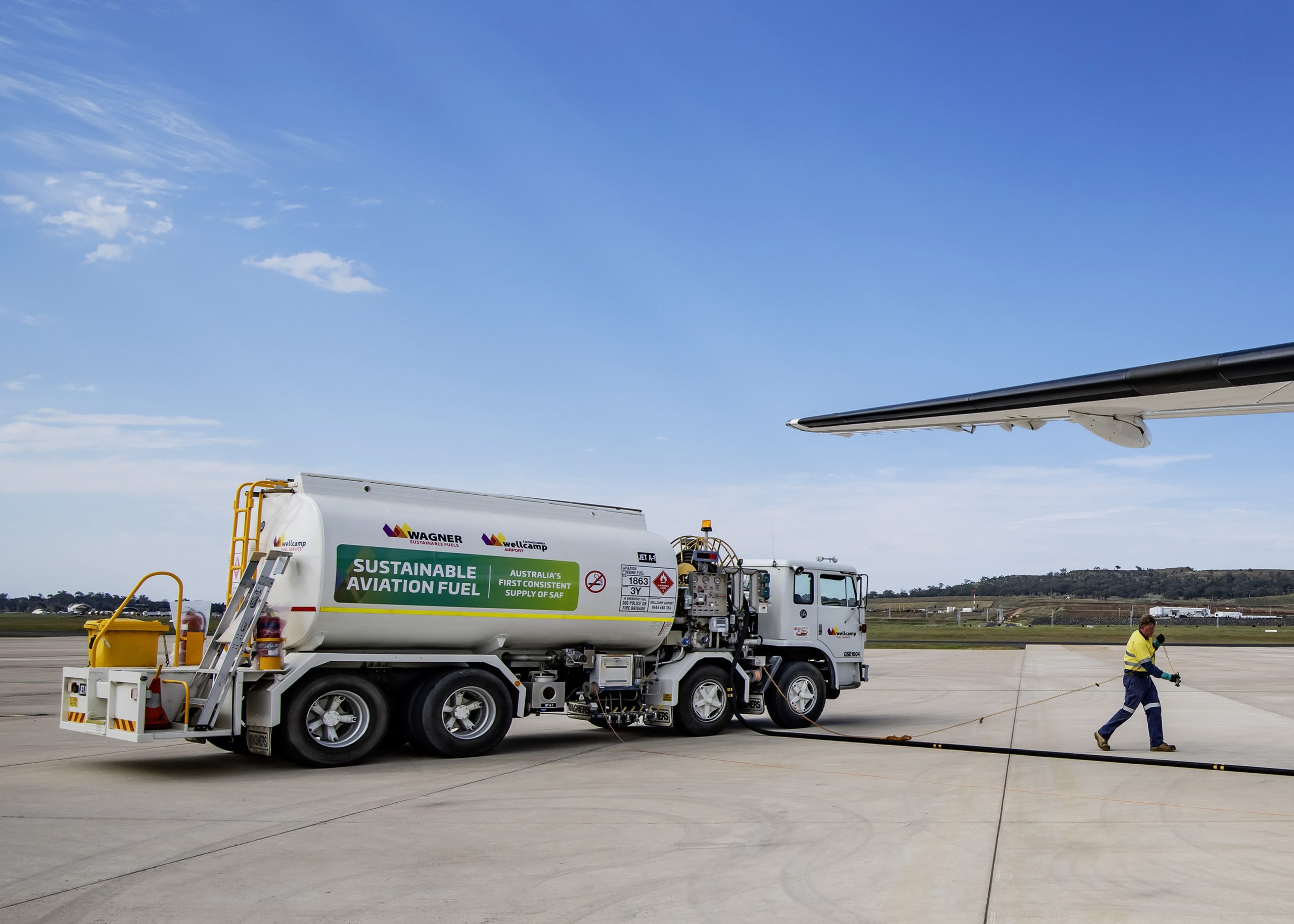
Cyan Ventures has launched a “Green Fuels Accelerator” (GFA) to advance commercial scale low carbon liquid fuel (LCLF) production. Funded by the Australian Renewable Energy Agency (ARENA) – with support from industry partners including Qantas and Boeing – the GFA has selected its first seven Australian LCLF projects to fast-track toward financial close and commercial production. The GFA provides tailored regulatory, technical, commercial and finance advisory support to de-risk projects and unlock domestic low carbon fuel supply, while reducing Australia’s reliance on imported fuel which frequently exceeds two-thirds of domestic demand. “The Green Fuels Accelerator is about converting Australia’s natural advantages into operating projects. We have the feedstocks, the innovative capacity, and willing partners across the supply chain to become a leader in low carbon fuel technology and production,” said Dr. Fraser Thompson, Managing Partner, Cyan Ventures. “The benefit of a thriving domestic SAF industry is clear. What’s missing is the targeted support to get early-stage projects across the line – the financing structures, the offtake agreements and the regulatory guidance that turns potential into production. We have a group of talented developers and entrepreneurs ready to build something the country genuinely needs and the Green Fuels Accelerator exists to make sure they can.” The pilot initiative will work with seven identified LCLF projects, providing specific commercialisation support in areas such as financing and commercial offtake. Industry partners including Qantas, Boeing, Mission Possible Partnership, Climate Tech Partners and SYSTEMIQ will provide project advisory support. Fiona Messent, Chief Sustainability Officer, Qantas, said: “Qantas is committed to reducing the emissions of Australian aviation and scaling a domestic sustainable aviation fuel industry is central to that goal. We’re pleased to provide our commercial and technical expertise to help the most promising projects reach production.” Dr. Kimberly Camrass, Head of Sustainability APAC, Boeing, said: “Boeing’s partnership on the Green Fuels Accelerator initiative marks a pivotal step towards securing Australia’s energy independence, growing regional economies, lowering long term fuel costs and advancing decarbonisation across the aviation sector.” Darren Miller, CEO, ARENA, said: “Australia has the potential to manufacture our own low carbon liquid fuels. We have abundant feedstocks, strong research capability and growing demand from sectors like aviation. What’s needed now is the support to help promising projects navigate the final steps to commercial scale. The Green Fuels Accelerator is about closing that gap and providing the targeted support needed to move projects from concept to construction and build Australia’s resilience to fuel shocks.” Technip Energies, Airbus, Safran and Tereos join forces on SAF project (IMAGE: Airbus) Technip Energies, Airbus, Safran and Tereos entered into an agreement to create Rebound, a joint venture to develop a large-scale Sustainable Aviation Fuel (SAF) production project at the Port of Dunkirk, in Northern France. The project will use the Alcohol-to-Jet (AtJ) technological pathway to produce approximately 160,000 tons of SAF per year, making it one of the largest facilities of its kind in Europe and contributing to European energy sovereignty. With this agreement, the partners commit to fund the project’s development phase, including engineering studies and other activities required to consider a Final Investment Decision (FID). SAF is widely recognised as the primary lever to decarbonise aviation. Under the European Union’s Refuel EU Aviation regulation, SAF blending mandates will rise progressively reaching 6% by 2030 and 70% by 2050, driving an eightfold increase in demand between 2030 and 2050. Among the available production pathways, Alcohol-to-Jet is emerging as a scalable and cost-competitive option which converts advanced ethanol, produced from agricultural and forestry residues into drop-in aviation fuel that can be blended with conventional jet fuel and used in existing engines and aircraft. In this project development phase, Technip Energies will act as the project’s lead developer and engineering service provider, bringing its expertise in technology scaling and complex project execution. Airbus and Safran, world-class leaders in global aerospace, join as industrial partners, offtake facilitators and potential SAF offtakers. As a European leader in ethanol production, Tereos, a French agricultural cooperative intends to supply and source the advanced ethanol required for the project. Together, the four partners cover the value chain from feedstock supply to aviation end-use, under a single European-led initiative. A key milestone was already reached: the Port of Dunkirk awarded Technip Energies an industrial site in Northern France, which will offer, upon finalisation of the joint venture, strong logistical advantages to Rebound for feedstock and product transport, as well as a streamlined permitting pathway. The partners will progress through a disciplined, stage-gated development process. Steps ahead include the selection of the technology licensor, permitting activities, launch of pre-FEED (Front-End Engineering Design) and FEED activities, finalisation of feedstock supply and SAF offtake agreements, and securing the financing for the construction of the asset. The creation of the joint venture is subject to customary closing conditions and approvals and is expected to be finalised in the second half of this year. Benjamin Lechuga, Chief Strategy and Sustainability Officer of Technip Energies, commented: “Sustainable Aviation Fuel is one of the most critical levers to decarbonise aviation, and the Alcohol-to-Jet pathway offers a credible, scalable route to get there. With Rebound, we are putting into practice our strategy to capture greater value through adjacent business models, originating and developing projects in fast-growing energy transition markets alongside recognised industry leaders such as Airbus, Safran and Tereos. We look forward to advancing this project with the engineering rigor and disciplined execution that define Technip Energies.” Julie Kitcher, Chief Sustainability Officer and Communications of Airbus, stated: “The Rebound project is a vote of confidence in SAF and in Europe’s ability to be a leader in the journey to decarbonise aviation. With renewable energy facing global headwinds, Airbus will work with our partners to open up an abundant new SAF pathway, Alcohol-to-Jet fuel, in France. This project aims to increase the availability of lower-carbon fuels, contribute to reducing aviation emissions and strengthen Europe’s energy supply security, while creating a new job market. I am delighted that Airbus is a partner in the Rebound project, which is a vital step forward for the SAF ecosystem in Europe.” Nathalie Stubler, Chief Sustainability Officer of Safran, commented: “Developing Sustainable Aviation Fuel at scale is essential for decarbonising air transport. This ambitious project brings together leading French and European expertise, supporting the emergence of a competitive SAF industry. By joining forces with our partners, Safran reaffirms its commitment to innovation and environmental responsibility, fully aligned with our strategy to reduce CO₂ emissions and support the energy transition in aviation. This commitment is reflected in our investments, through Safran Corporate Ventures, in the development of sustainable solutions for the aviation industry of tomorrow.” Jérôme Bos, Chief Strategy Officer of Tereos, declared: “We are delighted to contribute, through Rebound, to the emergence of the Alcohol-to-Jet industry in France, supporting the decarbonization of the aviation sector. This project is fully aligned with Tereos’ mission to develop low-carbon industrial value chains by creating value from agricultural production. Tereos will bring to the project its expertise and industrial assets dedicated to the production of advanced ethanol. It also provides a strong illustration of the development of a bioeconomy rooted in French and European agricultural production.” For Editorial Inquiries Contact: Editor Matt Driskill at [email protected] For Advertising Inquiries Contact: Head of Sales Sally Passey at [email protected]
Previous article
ATR continues to tout Vietnam as regional plane market
Asian Aviation staff is comprised of award-winning journalists based throughout the Asia-Pacific region led by Editor Matt Driskill. 《亚洲航空》的编辑团队由主编马特·德里斯基尔 (Matt Driskill) 带领,汇聚了遍布亚太地区的获奖记者。
Comments
Loading comments...