
Home › Manufacturers
Airbus opens new A320 FAL in China
Airbus predicts world freighter fleet to grow 45% by 2044
By Asian Aviation Staff
•Oct 23, 2025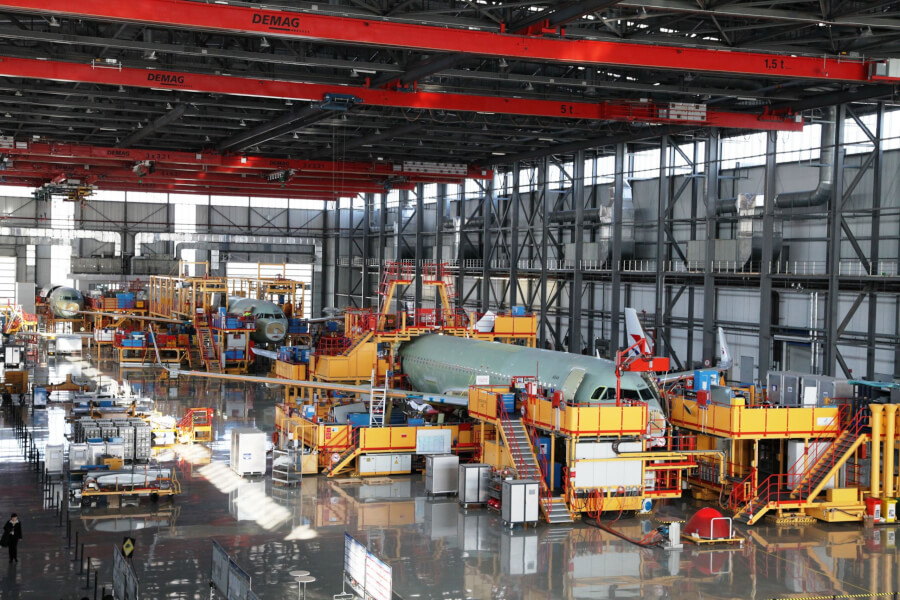
Airbus has opened its second Final Assembly Line (FAL) for the A320 Family aircraft in Tianjin, China. This milestone follows an earlier agreement signed in April 2023 by Airbus CEO, Guillaume Faury and the Tianjin Free Trade Zone Investment Company Ltd. and Aviation Industry Corporation of China Ltd.. Preparations to assemble the first aircraft are underway and full operation of the facility is targeted for early 2026. “We welcome the addition of Tianjin’s second line to our global production system, as it provides us with the necessary flexibility and capacity to deliver on our plan to assemble 75 A320 Family aircraft per month in 2027”, said Airbus CEO Guillaume Faury. “Over the past 40 years of our presence here in the country, we have come a long way in establishing trustful partnerships with the China civil aviation community, and we look forward to writing the next chapters of our future together.” The new line will enable Airbus to significantly increase production close to its customers in China and beyond. It complements the global Airbus production network of – now – ten Final Assembly Lines – four in Hamburg (Germany), two in Toulouse (France), two in Mobile (United States) and two in Tianjin (China). The advanced second line features Airbus’ latest technologies and processes to produce aircraft worldwide at the same Company’s highest standards. In addition, the facility takes advantage of electricity from renewable sources, reclaimed water and geothermal energy to support the company’s sustainability roadmap, reducing the Company’s environmental footprint. Inaugurated in 2008, the Airbus Tianjin FAL was the first Airbus production line for commercial aircraft outside Europe. It has assembled and delivered over 780 A320 Family aircraft since then, making the facility a symbol of successful Sino-European cooperation. Airbus predicts world freighter fleet to grow 45% by 2044 Airbus’s 2025 Cargo Global Market Forecast (GMF) shows the worldwide fleet of dedicated freighter aircraft rising to 3,420 in the next 20 years, equivalent to a 45% increase. This will be made up of 815 existing freighters and 2,605 additional ones. Of these additional 2,605 freighters, 1,530 will be replacements and 1,075 will be for growth. The additional 2,605 will be split between 1,120 small aircraft, 855 mid-size widebodies, and 630 large widebodies. Overall of the 2,605 additional freighters, 1,670 will be conversions from passenger aircraft and 935 will be new-build freighters. World Gross Domestic Product (GDP) and trade remain the main drivers of air cargo. With long term trade forecasted at 2.7% CAGR, Airbus forecasts that air cargo will develop at a rate of 3.3% annually over the next 20 years, effectively almost doubling cargo volumes over the next two decades. Airbus forecasts significant air cargo growth as it has proved essential – not just to support economies, but also to connect remote communities, transport essential and health-critical goods, and enable local business development in emerging countries. After rapid cargo fleet growth during the pandemic, fuelled by an increase of passenger aircraft conversions into freighters and minimum retirement of previous generation freighters, Airbus forecasts that going forward, a large proportion of these older freighters will leave the fleet and be replaced by newer, more fuel efficient freighters such as the A350F or A320/A321 and A330 Passenger-to-Freighter (P2F) conversions. Airbus also forecasts trade lanes, and therefore air cargo flows diversification, as more countries in the Asia-Pacific region become industrial centres. Likewise, GDP and demographic forecasts indicate that new countries such as Brazil, Indonesia or Vietnam will emerge as major consumer economies in the coming decades. This will initiate a gradual shift in air cargo geography and the global air freight map. Of the total need for 2,605 freighter deliveries over the next 20 years, Asia-Pacific and North America will account for nearly two-thirds of demand, requiring 850 and 920 aircraft, respectively. For Editorial Inquiries Contact: Editor Matt Driskill at [email protected] For Advertising Inquiries Contact: Head of Sales Kay Rolland at [email protected]
TAGSAirbusChina
Previous article
Korean Air acquires stake in WestJet’s parents
Asian Aviation Staffhttps://asianaviation.com/
Asian Aviation staff is comprised of award-winning journalists based throughout the Asia-Pacific region led by Editor Matt Driskill. 《亚洲航空》的编辑团队由主编马特·德里斯基尔 (Matt Driskill) 带领,汇聚了遍布亚太地区的获奖记者。